Chemical Level of Organization
- 2.1 How matter is organized, p. 40
- identify the main chemical elements of the human body.
- 26 chemical elements normally are present in human's body.
- 4 Major elements, constitute about 96% of the body's mass
- Oxygen takes up 65%, part of water and many organic molecules, used to generate ATP for cells to temporarily store chemical energy
- Carbon takes up 18.5%, forming backbone chains and rings of all organic molecules, e.g. carbohydrates, lipids, proteins, and nucleic acids (DNA and RNA)
- Hydrogen accounts for 9.5%, as constituent of water and most organic molecules, the ionized form
makes body fluid more acidic - Nitrogen, 3.2%, as components of all proteins and nucleic acids
- 8 Lesser Elements, contributing 3.6% to the body's mass
- calcium (Ca), of 1.5%, contribute to hardness of bones and teeth; ionized form (Ca2+) needed for blood clotting, release of some hormones, contraction of muscle, and many other processes.
- phosphorus (P), of 1.0%, a component of nucleic acids and ATP, required for normal bone and tooth structure
- potassium (K), of 0.35%, ionized form (K+) being one of the most plentiful cation in intracellular fluid, needed to generate action potentials
- sulfur (S), sodium (Na), chlorine (Cl), magnesium (Mg), iron (Fe)
- 14 trace elements, present in tiny amount, account for the remaining 0.4% of the body mass, with important functions in the body, e.g.
- iodine is needed to make thyroid hormones.
- 4 Major elements, constitute about 96% of the body's mass
- 26 chemical elements normally are present in human's body.
- describe the structures of atoms, ions, molecules, free radicals, and compounds.
- Structure of Atoms
- Each element is made up of atoms, the smallest unit of matter retaining the properties and characteristics of the element.
- Different subatomic particles compose individual atom, including
- Positively charged proton (
), unchar**d neutrons ( ) are inside the nucleus (dense central core of an atom) - The tiny, negatively charged electrons (
) move surrounding the nucleus to form a negatively charged "cloud" enveloping the nucleus - Though the exact positions cannot be predicted, specific groups of electrons are mostly likely to move around the nucleus within certain regions called electron shells, depicted as simple circles around the nucleus;
- the first and nearest the nucleus never holds more than 2 electrons,
- the 2nd holds a max of 8 electrons, and
- the third can hold up to 18 electrons.
- Though the exact positions cannot be predicted, specific groups of electrons are mostly likely to move around the nucleus within certain regions called electron shells, depicted as simple circles around the nucleus;
- Positively charged proton (
- Ion, Molecules, and Compounds
- An atom giving up or gaining electrons becomes an ion, with a positive or negative charge due to unequal numbers of protons and electrons
- ionization is the process of giving up or gaining electrons
- Molecule is the combination of two or more atoms (same or different) sharing electrons
- Compounds contain atoms of 2 or more different elements
- Free radical, an atom or group of atoms with an unpaired electron in its outermost shell, e.g. superoxide is formed by the addition of an electron to an oxygen molecule
- Structure of Atoms
- Chemistry
- the science of the structure and interactions of matter (constituting all living and nonliving things; anything occupying space and has mass)
- Mass is the amount of matter in any object, doesn't change
- Weight is the force of gravity acting on matter; does change (e.g. the weight of an astronaut is close to 0 in outer space)
- Chemical elements
- a limited number of building blocks that can make up all forms of matter (both living and nonliving); each cannot be split into simpler substance by ordinary chemical means. 118 elements are currently recognized by scientists and among which 92 occur naturally on earth.
- Each named element is designated by a chemical symbol, e.g. Na for sodium
- Atomic number and Mass number
- Atomic number (number of protons) distinguishes the atoms of one element from another, e.g. oxygen has an atomic number of 8
- Mass number of an atom is the sum of its protons and neutrons, e.g. for sodium, it's 23
- Isotopes are different atoms of an element that have the same number of protons but different numbers of neutrons, and thus have different mass numbers, e.g. O-17
- Radioactive isotopes (radioisotope) are unstable and their nuclei decay (spontaneously emitting radiation of subatomic particles or packets of energy into a stable configuration, often a different element), e.g. C-14 decays to N-14
- Half-life of an isotope, time required for half of the radioactive atoms in a sample of the isotope to decay into a more stable form, e.g. half-life of C-14 is about 5730 years, half-life of I-131 (important clinical tool) is 8 days
- Atomic mass
- Dalton is the standard unit for measuring the mass of atoms and their subatomic particles, e.g.
- neutron has a mass of 1.008 Daltons,
- proton has a mass of 1.007 Daltons, and
- the mass of electron is 0.0005 Dalton
- Atomic mass, aka atomic weight, average mass of all naturally occurring isotopes of that element.
- identify the main chemical elements of the human body.
- 2.2 Chemical Bonds, p. 43
- describe how valence electrons form chemical bonds.
- Chemical bonds are forces of attractions holding atoms together from gaining, losing, or sharing electrons in the valence shell (outermost electron shell model)
- Octet rule is a chemical principle that 2 or more atoms can interact in ways that produce a chemically stable arrangement of 8 valence electrons for each atom;
- Chemical bonds are forces of attractions holding atoms together from gaining, losing, or sharing electrons in the valence shell (outermost electron shell model)
- distinguish among ionic, covalent, and hydrogen bonds.
- Ionic bonds
- the force of attraction holding together ions with opposite charges
- positive charged ions are cations and negatively charged ions are anions
- Electrolyte is an ionic compound breaking apart into positive and negative ions in solution. The solutions can conduct an electric current.
- Covalent bond
- forms when atoms share pairs of valence electrons (single , double or triple) and the larger the number of electron pairs shared b/w 2 atoms, the stronger the bond.
- Single covalent bond results when two atoms share one electron pair, e.g. in
- Double covalent bond results when 2 atoms share 2 pairs of electrons, as in
- Triple covalent bond occurs when 2 atoms share 2 pairs of electrons, as in
- In a nonpolar covalent bond, 2 atoms share the electrons equally, e.g. bonds b/w identical icons; bonds b/w C and H atoms, the 4 C-H bonds in a methane molecule
- In a polar covalent bond the sharing of electrons b/w 2 atoms is unequal => 1 atom attracting electrons more strongly has a partial negative charge, e.g. in a molecule of water, the O atom is said to have greater Electronegativity (the power to attract electrons to itself, indicated by
, in a polar covalent bond, the sharing of electrons between 2 atoms are unequal => the resulting molecule has a partial negative charge ( ) near the atom that attracts electrons more strongly)
- Hydrogen bond (p. 46, forms when a H atom with a partial positive charge attracts the partial negative charge of neighboring electronegative atoms, most often larger O or N atoms)
- weak compared to ionic and covalent bonds
- do establish important links b/w molecules or b/w different parts of a large molecule, such as a protein or nucleic acid
- links neighboring water molecules give water considerable cohesion (tendency of particles alike to stay together) which creates a very high surface tension that makes it difficult to stretch or break the surface of water.
- Ionic bonds
- helps explain why atoms interact in predictable ways in emptying, filling or share electrons with other atoms in the valence shell
- to be more stable chemically @@
- describe how valence electrons form chemical bonds.
- 2.3 Chemical reaction, p. 47
- define a chemical reaction.
- A Chemical reaction occurs when new bonds form or old bonds break b/w atoms; foundation of all life processes
- describe the various forms of energy.
- Forms of Energy and Chemical Reactions
- Energy, the capacity to do work, has 2 principal forms: potential energy (stored by matter due to its position) and kinetic energy (energy associated with matter in motion)
- Chemical energy is a form of potential energy stored in the bonds of compounds and molecules
- Law of conservation of energy is total amount of energy present at the beginning and end of a chemical reaction remain the same.
- Forms of the energy may be converted from one to another;
- the conversion of energy generally releases heat, some of which may be used to maintain normal body temperature;
- e.g. chemical energy in the foods eaten is eventually converted into various kinetic energies like mechanical energy for walking and talking.
- Forms of Energy and Chemical Reactions
- compare exergonic and endergonic chemical reactions.
- Energy transfer in Chemical reactions
- Exergonic reactions (release more energy than they absorb;)
- Endergonic reactions (absorb more energy than they release; require energy; e.g. Synthesis reactions are usually endergonic)
- Energy transfer in Chemical reactions
- explain the role of activation energy and catalysts in chemical reactions.
- Activation energy (the collision energy needed to break the chemical bonds of reactants; also the initial energy investment needed to start a reaction)
- reactions are more likely to happen when the concentrations (the more particles of matter present in a confined spaced, the greater the chance that they will collide) and the temperatures (as temperature rises, particles of matter move about more rapidly) of the reacting particles are higher
- Catalysts accelerate chemical reactions by lowering the Activation energy required for a reaction to occur: in living organisms mostly are protein molecules called enzymes
- Activation energy (the collision energy needed to break the chemical bonds of reactants; also the initial energy investment needed to start a reaction)
- describe synthesis, decomposition, exchange, and reversible reactions.
- Types of chemical reactions
- Synthesis reactions are anabolic (less molecules) and usually endergonic as they usually absorb more energy than they release, e.g. amino acids to form large molecules like proteins
- Decomposition reactions are catabolic and usually exergonic, where the substance broken down into smaller atoms, ions, or molecules
- Exchange reactions involve the replacement of one atom or atoms by another atom or atoms
- In reversible reactions, the products can revert to the original reactants, indicated by 2 half-arrows pointing in opposite directions
- Types of chemical reactions
- The starting substances are reactants, and the ending ones are products
- metabolism refers to all chemical reactions occurring in the body.
- Oxidation-reduction reactions break down food molecules to produce energy, always parallel, when one substance oxidized, another reduced at the same time
- In Oxidation (the loss of electrons), the oxidized substance releases energy (e.g. glucose oxidized for cells to carry out functions)
- In Reduction (the gain of electrons), the reduced substance gains energy
- define a chemical reaction.
- 2.4 Inorganic compounds and Solutions, pp. 50-52
- describe the properties of water and those of inorganic acids, bases, and salts.
- Water attributes pp. 50-51
- Inorganic acids, bases, and salts
- When inorganic acids, bases, and salts dissolve in water, they dissociate by separating into ions and being surrounded by water molecules
- An acid is a substance that dissociate into one or more hydrogen ions and one or more anions.
- As hydrogen ion is a single proton with one positive charge, it's also referred to as a proton donor.
- A base dissociates into one or more hydroxide ions and one or more cations; removes hydrogen ions from a solution and is there a proton acceptor,
- A salt dissociates into cations and anions when dissolved in water, e.g. potassium chloride as electrolytes vital for carrying electrical currents esp. in nerve and muscular tissues.
- distinguish among solutions, colloids, and suspensions.
- Solutions, Colloids, and Suspensions
- Mixture is the combinations of elements or compounds physically blended together but not bound by chemical bonds; e.g. 3 common liquid mixture: solutions, colloids, suspensions
- A colloid differs from a solution by the size of its particles in that the solute particles are large enough to scatter light, thus usually appearing opaque, e.g.
- large milk protein make milk a colloid whereas calcium salts, lactose, ions and other small particles are in solution
- In a suspension, the suspended material may mix with the liquid or suspending medium for some time, and eventually will settle out, as compared with colloids and solutions where the solutes do not settle out and accumulate at the bottom of the container. e.g.
- After blood sits for a while in a tube, red blood cells settle out and drift to the bottom of the tube, while the upper layer appearing pale yellow called blood plasma being both a solution of ions and small solutes as well as a colloid due to presence of larger plasma proteins
- The concentration of a solution may be expressed in:
- a mass per volume percentage giving the relative mass of a solute found in a given volume of solution, e.g. alcohol 14.1% by volume
- units of moles per liter (mol/L, molarity) relating to the total number of molecules in a given volume of solution; mole is the amount in grams of any substance of a mass equal to the combined atomic mass of all its atoms, e.g. 1 mole of the salt sodium chlorine NaCl is 58.44 gram, a mole of anything has the same number of particles:
)
- Solutions, Colloids, and Suspensions
- define pH and explain the role of buffer systems in homeostasis.
- Acid-base balance: the concept of pH
- to ensure Homeostasis, the intracellular and Extracellular fluids must contain almost balanced quantities of acids and bases.
- A solution's acidity or alkalinity is expressed on a pH scale extending from 0 to 14, based on the concentration of hydrogen ions in mol/L (in logarithmic)
- An acidic solution has more H+ than OH- and has a pH below 7; while basic solution (alkaline) a solution with more OH- than H+, and has a pH above 7.
- Normal blood pH: 7.35-7.45
- Maintaining pH: Buffer systems
- Buffer systems function to convert strong acids or bases into weak acids or bases to help maintain pH homeostasis, e.g.
- Buffers are chemical compounds converting strong acids or bases into weak ones by removing or adding protons (H+)
- carbonic acid-bicarbonate buffer system
- carbonic acid
(weak acid) as a weak acid adds H+, whereas - bicarbonate ion
(weak base) act as a weak base, removes excess H+
- carbonic acid
- Acid-base balance: the concept of pH
- Inorganic compounds usually have simple structure and lack carbon, while
organic compounds always contain carbon, usually hydrogen, and always have covalent bonds.
- describe the properties of water and those of inorganic acids, bases, and salts.
- 2.5 Overview of Organic compounds, p. 54
- define the term functional group as it relates to organic molecules.
- Distinctive functional groups attached to the carbon skeleton (chain of carbon atoms in an organ molecule) are other atoms or molecules bound to the hydrocarbon skeleton (carbon bonded to hydrogen atoms)
- each has a specific arrangement of atoms conferring characteristic chemical properties on the organic molecule
- Distinctive functional groups attached to the carbon skeleton (chain of carbon atoms in an organ molecule) are other atoms or molecules bound to the hydrocarbon skeleton (carbon bonded to hydrogen atoms)
- distinguish between monomers and polymers.
- Small organic molecules combine into large molecules called macromolecules, usually polymers, large molecules formed by the covalent bonding of many identical or similar small building-block molecules called monomers
- molecules with the same molecular formula but different structures are isomers, e.g. C6H12O6 for sugars glucose and fructose. Isomers have different chemical properties
- define the term functional group as it relates to organic molecules.
- 2.6 Carbohydrates, p. 55
- identify the building blocks of carbohydrates.
- Carbohydrates (watered carbon) include sugar, glycogen, starches, and cellulose, representing 2-3% of the total body mass.
- C, H, O are the elements found within, and the ratio of H to O atoms is usually 2:1, same as in water.
- functional group @@
- describe the functions of carbohydrates.
- mainly a source of chemical energy for generating ATP needed to drive metabolic reactions.
- a few used for building structural units e.g. deoxyribose, a building block of DNA
- 3 main group: monosaccharides, disaccharides, and polysaccharides
- Monosaccharides and disaccharides: the simple sugars
- Monosaccharides, the monomers of carbohydrates, contain 3-7 carbon atoms, designated by names ending in "-ose" with a prefix indicating the number of carbon atoms, e.g., trioses, tetroses, pentoses (5-carbon sugars), hexoses, heptoses. Cells in the body break down the hexose glucose to produce ATP
- A disaccharide is a molecule formed from the combination of 2 monosaccharides by dehydration synthesis
- Polysaccharides
- each polysaccharide molecule contains tens or hundreds of monosaccharides joined thru dehydration synthesis reactions.
- Unlike simple sugars, polysaccharides usually are insoluble in water and do not taste sweet.
- glycogen, the main polysaccharide in the human body, is made entirely of glucose monomers linked to one another in branching chains
- Monosaccharides and disaccharides: the simple sugars
- identify the building blocks of carbohydrates.
- 2.7 Lipids, p.57
- identify the different types of lipids.
- include: fatty acids, triglycerides (fats and oils), phospholipids, steroids (lipids containing rings of carbon atoms), eicosanoids (20-carbon lipids), and a variety of other substances including fat-soluble vitamins like (A, D, E, K) and lipoproteins.
- Fatty acids
- consists of a carboxyl group and a hydrocarbon chain
- Lipids make up 18-25% of body mass in lean adults, containing C, H, O.
- The proportion of electronegative oxygen atoms in lipids is usually smaller than in carbohydrates, meaning there are fewer polar covalent bonds, thus most lipids are insoluble in polar solvents like water, being hydrophobic.
- Triglycerides
- consisting of a single glycerol molecule and 3 fatty acid molecules attached by dehydration synthesis reactions
- stored in adipose (fat) tissue.
- The 3-carbon glycerol molecule forms the backbone of a triglyceride
- Phospholipids
- Phospholipids, like triglycerides, have a glycerol back-bone and 2 fatty acid chains attached to the first 2 carbons, and in the 3rd position, a phosphate group links a small charged group usually containing N to the backbone as head; and thus amphipathic
- The head portion is polar and can form Hydrogen bonds with water molecules.
- The 2 fatty acids as tails are nonpolar and can interact only with other lipids.
- Steroids
- The structure of steroids differs much from that of triglycerides; has 4 rings of carbon atoms; body cells synthesize other steroids from cholesterol that has a large nonpolar region consisting of 4 rings and a hydrocarbon tail;
- The commonly encountered steroids in the body like below are known as sterols as they also have at least one hydroxyl group (-OH), making sterols weakly amphipathic (both polar and nonpolar)
- Other lipids like eicosanoids
- Eicosanoids, lipids derived from a 20-carbon fatty acid called arachidonic acid; has 2 principal subclasses are prostaglandin and leukotrienes.
- Lipoproteins, the lipid-protein complexes formed by lipid molecules joined and housed with hydrophilic protein molecules to become more soluble in blood plasma.
- discuss the functions of lipids.
- Fatty acids, one of the simplest lipids, used to synthesize triglycerides and phospholipids; can also be catabolized to generate ATP
- triglycerides (triacylglycerols), the most plentiful lipids in human body and in the diet, protect, insulate, and provide energy;
- the body's most highly concentrated form of chemical energy, providing twice as much energy per gram as do carbohydrates and protein;
- Phospholipids are important cell membrane components
- Steroids
- cholesterol needed for cell membrane structure,
- estrogens & testosterone required for regulating sexual functions,
- cortisol necessary for maintaining normal blood sugar levels,
- bile salts needed for lipid digestion and absorption, and
- vitamin D, related to bone growth
- Eicosanoids
- prostaglandins have various functions:
- modify responses to hormones,
- contribute to the inflammatory response,
- prevent stomach ulcers,
- dilate airways to the lungs,
- regulate body temperature, and
- influence formation of blood clots, etc.
- leukotrienes participate in allergic and inflammatory responses
- modify hormone responses, contribute to inflammation, dilate airways, and regulate body temperature
- prostaglandins have various functions:
- Fatty acids can be saturated or unsaturated
- A Saturated fatty acid contains only single covalent bonds b/w the carbon atoms of the hydrocarbon chain, thus each carbon atom of the hydrocarbon chain is saturated with hydrogen atoms.
- An unsaturated fatty acid contains one or more double covalent bonds b/w the carbon atoms of the hydrocarbon chain, thus not completely saturated with hydrogen atoms.
- a fat mainly consisting of saturated fatty acids is saturated fat, occurring mostly in meats (esp. red meats) and non-skim dairy products (whole milk, cheese, butter), also in plant products (cocoa butter, palm oil, coconut oil).
- Diets containing large amounts of saturated fats are associated with disorders e.g. heart disease and colorectal cancer.
- The fatty acids of an oil can be:
-
- monounsaturated fats contain triglycerides mostly consisting of monounsaturated fatty acids; constituting olive oil, peanut oil, canola oil, nuts, and avocados
-
- polyunsaturated fats contain triglycerides mostly consisting of poly-unsaturated fatty acids, found of high percentage in corn oil, safflower oil, sunflower oil, soybean oil, and fatty fish (salmon, tuna, mackerel
-
- both believed to decrease the risk of heart disease.
-
- identify the different types of lipids.
- 2.8 Proteins, p. 60
- identify the building blocks of proteins.
- Proteins, large molecules containing C, H, O, and N, and sometimes S, making up 12-18% of a lean adult body; has a much more complex structure than carbohydrates or lipids, largely responsible for the structure of body tissues;
- describe the functional roles of proteins.
- catalytic: enzymes are proteins speeding up most biochemical reactions
- contractile: some proteins work as motors to drive muscle contraction
- immunological: antibodies are proteins depending against invading microbes
- regulatory: some hormones are proteins regulating homeostasis
- transport: carry vital substances throughout the body
- structural: collagen in bone, keratin in skin
- Amino acids and polypeptides
- amino acids, the monomers of proteins, each of the 20 different kinds has a H atom and 3 important functional groups attached to a central carbon atom; at the normal pH of body fluids, both the amino group and the carboxyl group are ionized
-
- an amino group -NH2
-
- an acidic carboxyl group -COOH
-
- a side chain -R group gives distinctive chemical identity
-
- The covalent bond joining each pair of amino acids is a peptide bond, always forming b/w the carbon of the carboxyl group of one amino acid and the nitrogen of the amino group of another via a dehydration synthesis reaction; breaking the bond occurs during digestion of dietary proteins is a hydrolysis reaction.
- When 2 amino acids combine, a dipeptide results
- Adding another amino acid to a dipeptide produces a tripeptide
- Further additions of amino acids result in the formation of
- a chainlike peptide (4-9 amino acids) or
- polypeptide (10-2000 or more amino acids): small proteins may consist of a single chain with as few as 50 amino acids; larger proteins have hundreds or thousands of amino acids and may consist of 2 or more chains folded together
- Levels of structural organization among protein: primary, secondary, tertiary, and sometimes quaternary; variations in protein structure and shape are related to their diverse functions
- If a protein encounters an altered environment, it may unravel and lose its characteristic shape (secondary, tertiary, quaternary structure), a process called denaturation; denatured proteins are no longer functional while in some cases can be reversed.
- amino acids, the monomers of proteins, each of the 20 different kinds has a H atom and 3 important functional groups attached to a central carbon atom; at the normal pH of body fluids, both the amino group and the carboxyl group are ionized
- Enzymes
- Most catalysts in living cells are protein molecules called as enzymes, usually end in "-ase", grouped based on the types of chemical reactions they catalyze
- oxidases add O2,
- kinases add phosphate,
- dehydrogenases remove hydrogen,
- ATPases split ATP,
- anhydrases remove water,
- proteases break down protein,
- lipases break down triglycerides.
- Some enzymes consist of 2 parts: a protein portion apoenzyme and a nonprotein portion cofactor (can be a metal ion like ion, or an organic molecule coenzyme derived from vitamins)
- Enzymes catalyze specific reactions with great efficiency and with many build-in controls, including 3 important properties
- highly specific - each enzyme recognizes and binds only to specific substrates (reactant molecules that the enzyme acts on using a characteristic 3-dimensional shape with a specific surface config) to catalyze a specific reaction; some cases where the active site (part of enzymes catalyzing the reaction) is thought to fit the substrate like a key fits in a lock, other cases it changes its shape (induced fit) to fit snugly around substrate once it enters the active site
- very efficient - under optional conditions, enzymes can catalyze reactions at rates from 100 million to 10 billion times more than the ones without enzymes. Number of substrate molecules a single enzyme molecule can convert to product molecules in 1s is generally b/w 1 and 10,000 and can be as high as 600,000
- subject to a variety of cellular controls - the rate of enzyme synthesis and concentration any time are under the control of a cell's genes via enhancement or inhibition on enzyme activities. may enzymes have both active and inactive forms in cells.
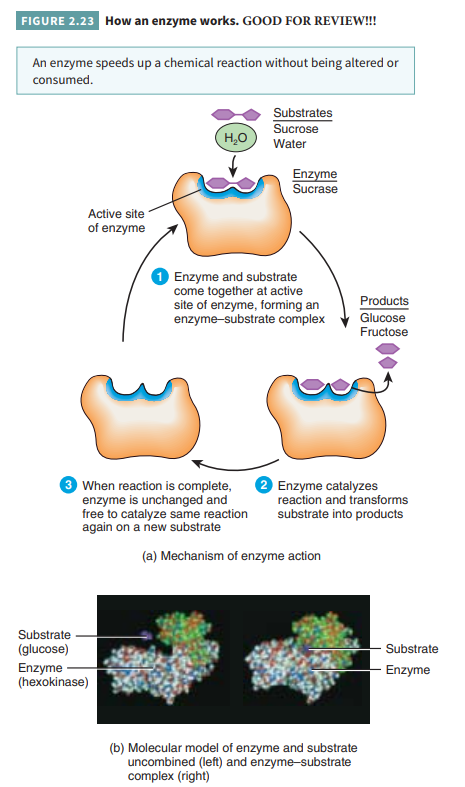
- How an enzyme works
-
- the substrates make contact with the active site on the surface of the enzyme molecule, forming a temporary intermediate compound called enzyme-substrate complex
-
- the substrate molecules transformed by the rearrangement of existing atoms, the breakdown of the substrate molecule, or the combination of several substrate molecules into the products of the reaction.
-
- upon completion of reaction and the dissociation of reaction products from the enzyme, the unchanged enzyme is free to attach to other substrate molecules
-
- Most catalysts in living cells are protein molecules called as enzymes, usually end in "-ase", grouped based on the types of chemical reactions they catalyze
- identify the building blocks of proteins.
- 2.9 Nucleic acids, p. 64
- distinguish between DNA and RNA.
- Nucleic acids were first discovered in the nuclei of cells, are huge organic molecules containing C, H, O, N, P; has 2 kinds: DNA and RNA
- Deoxyribonucleic acid (DNA) forms the inherited genetic material inside each human cell.
- Each gene, a segment of a DNA molecule, determines the traits inherited, and regulates most activities in body cells throughout our lives by controlling protein synthesis
- Ribonucleic acid (RNA) relays instructions from the genes to guide each cell's synthesis of proteins from amino acids.
- describe the components of a nucleotide.
- A nucleic acid is a chain of repeating monomers called nucleotides
- Each nucleotide of DNA consists of 3 parts: nitrogenous base, pentose sugar, and phosphate group
- nitrogenous base in DNA contains C, H, O, N; of 4 types, including adenine (A), guanine (G), thymine (T), cytosine (C), and
- purines are larger double-ring bases: A, G
- Pyrimidines are smaller single-ring bases: T, C (and U in RNA)
- A pairs with T (in RNA with U); C pairs with G
- a nucleotide is named according to its base
- pentose sugar, a 5-carbon sugar called deoxyribose attaches to each base in DNA
- phosphate group,
, alternate with pentose sugars to form the backbones of a DNA strand with the bases project inward the 2 backbone chain strands. - In the Watson-Crick double helix model, DNA resembles a spiral ladder. 2 strands of alternating phosphate groups and deoxyribose sugars forming the uprights, and paired bases, held together by hydrogen bonds forming the rungs.
- In humans, RNA is single-stranded, and the sugar in the RNA nucleotide is the pentose ribose, and it contain the pyrimidine base uracil instead of thymine.
- distinguish between DNA and RNA.
- 2.10 Adenosine Triphosphate, p. 67
- describe the functional role of adenosine triphosphate (ATP).
- Adenosine triphosphate (ATP) is the energy currency, the principal molecule transferring the energy liberated in Exergonic catabolic reactions to power cellular activities that require energy in living systems, e.g.
- muscular contractions,
- movement of chromosomes during cell division,
- movement structures within cells,
- transport of substances across cell membranes,
- synthesis of larger molecules from smaller ones.
- Adenosine triphosphate (ATP) is the energy currency, the principal molecule transferring the energy liberated in Exergonic catabolic reactions to power cellular activities that require energy in living systems, e.g.
- consist of 3 phosphate groups attached to adenosine, a unit composed of adenine and the 5-carbon sugar ribose.
- When a water molecule is added to ATP, the 3rd phosphate group is removed, and the overall reaction catalyzed by the enzyme ATPase liberates energy, producing a molecule called adenosine diphosphate (ADP)
- As the supply of ATP is limited, a mechanism will replenish it by adding a phosphate group to ADP catalyzed by ATP synthase to replenish ATP using the energy supplied mainly by the catabolism (decomposition reactions) of glucose in a process called cellular respiration
- Cellular respiration has 2 phases
- Anaerobic phase, oxygen not required, and glucose partially broken down by a series of catabolic reaction into pyruvic acid. Each glucose molecule converted to a pyruvic acid yields 2 ATP molecules.
- Aerobic phase, with oxygen present, glucose is completely broken down into CO2 and water, each glucose molecule generate heat and 30 or 32 ATP molecules
- describe the functional role of adenosine triphosphate (ATP).